
Introduction
In the modern digital landscape, acquiring high-quality backlinks is no longer about sending automated mass emails or buying cheap directory listings. Search engine algorithms continuously evolve to prioritize genuine user value, contextual relevance, and editorial integrity. To rank competitively on search engine result pages (SERPs), businesses must adopt a sophisticated digital PR and publisher outreach strategy. This comprehensive guide explores how strategic link building works, how to structure scalable campaigns, and how leveraging specialized platform features like PB Outreach Services allows brands to build permanent organic authority without risking manual algorithmic penalties.
1. Core Principles and Foundations
Understanding the core Definition of digital outreach is essential before launching any campaign. At its foundation, online outreach is the proactive practice of connecting with relevant publishers, industry journalists, and content creators to earn contextual mentions and high-value backlinks.
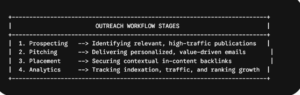
OUTREACH WORKFLOW STAGES
A step-by-step strategic process to acquire high-authority backlinks and build long-term publisher relationships.
1. Prospecting: Identifying Relevant, High-Traffic Publications
Researching and vetting high-authority websites within your target industry. We analyze domain metrics, organic traffic trends, audience engagement, and editorial standards to ensure every prospective host site is legitimate, active, and contextually aligned with your brand.
2. Pitching: Delivering Personalized, Value-Driven Emails
Reaching out directly to section editors, blog managers, and webmasters with tailored pitch messages. We focus on proposing high-quality content ideas, original insights, data benchmarks, and resource updates that genuinely add value to their existing readers rather than sending generic automated pitches.
3. Placement: Securing Contextual In-Content Backlinks
Crafting well-researched, engaging content that complies with strict editorial guidelines. Your brand mention and backlink are naturally embedded within the main body of the article as a helpful reference, ensuring maximum link equity transfer and attracting qualified referral traffic.
4. Analytics: Tracking Indexation, Traffic, and Ranking Growth
Monitoring live placements to verify proper indexing by search engines. We continuously track key performance indicators including target keyword position movements, page authority growth, organic referral visitors, and overall campaign return on investment (ROI).
When evaluating your distribution options, a direct Comparison between press releases and targeted blogger outreach highlights key differences:
-
Press Release Distribution: Broad syndication across news wires that yields short-term visibility, often with nofollow links.
-
Direct Blogger Outreach: Contextual placements in relevant articles that build permanent search authority and referral traffic.
Developing a clear Strategy allows marketing teams to focus on quality over quantity. Establishing these core Fundamentals early prevents common pitfalls like targeting low-quality directories or sending generic bulk emails.
2. Campaign Planning and Execution
A successful campaign follows a structured Process designed for efficiency and high conversion rates:
-
Discovery: Research active publications within your target vertical.
-
Qualification: Verify site traffic, editorial guidelines, and audience engagement.
-
Communication: Craft customized pitch messages that solve a publisher’s need.
-
Content Creation: Produce insightful, well-researched contributions that blend naturally into host platforms.
Finding target websites requires dedicated Prospecting methods, such as utilizing advanced search operators, analyzing competitor backlink profiles, and monitoring industry conversations.
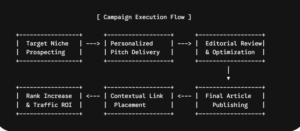
CAMPAIGN EXECUTION FLOW
A end-to-end framework designed to turn cold outreach into high-converting, permanent backlink placements.
Step 1. Target Niche Prospecting
Finding and filtering high-authority, niche-relevant websites. In this initial phase, we use advanced search operators and competitor backlink analysis to identify active blogs and publications. Every domain is thoroughly vetted for organic search traffic, domain authority, audience alignment, and content freshness to ensure your site gets backlinks from real, trustworthy sources.
Step 2. Personalized Pitch Delivery
Reaching out directly to site owners, section editors, and content managers with customized communication. Instead of sending generic mass templates, we craft personalized value propositions. We highlight content gaps on their site, offer exclusive data or expert quotes, and pitch relevant topics that fit their audience’s exact interests.
Step 3. Editorial Review & Optimization
Collaborating with publisher editorial teams to align on topic direction, content guidelines, and brand requirements. Once a pitch is accepted, we create or refine the content to ensure it meets strict editorial standards, matches the tone of the host publication, and complies with modern search engine guidelines.
Step 4. Final Article Publishing
Securing the official publication of the approved article on the target website. During this phase, we verify that the article is live, properly formatted, accessible to readers, and free from technical errors or broken media elements.
Step 5. Contextual Link Placement
Ensuring your brand mention and target URL are embedded naturally within the main body of the content. We place links contextually surrounded by relevant keyword anchors to maximize authority transfer (link equity) and drive qualified referral traffic directly to your key landing pages.
Step 6. Rank Increase & Traffic ROI
Monitoring indexation and tracking campaign results over time. We analyze search engine indexing, measure keyword position improvements, monitor domain authority growth, and evaluate organic traffic increases to calculate the true return on investment (ROI) for your campaign.
The success of your outreach relies heavily on your Pitching strategy. Editors receive dozens of inquiries daily; a concise pitch that highlights clear value will always outperform generic templates.
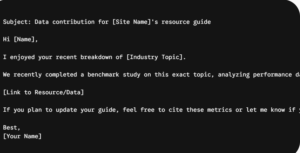
OUTREACH EMAIL TEMPLATE BREAKDOWN
A proven cold outreach email framework designed to secure high-quality resource links and publisher quotes by offering original data and value first.
1. Subject Line: Data contribution for [Site Name]’s resource guide
-
Purpose: Grabs the editor’s attention immediately by mentioning their specific website name and offering value.
-
Why it works: Section editors receive hundreds of sales pitches daily. Specifying “Data contribution” makes it clear that you are offering free research rather than asking for a favor or selling a service.
2. Personalized Opening: Hi [Name], I enjoyed your recent breakdown of [Industry Topic].
-
Purpose: Proves that you have actually visited their site and read their work.
-
Why it works: Personalization builds trust right away. Showing appreciation for their existing content creates a warm connection and proves your email is not automated spam.
3. Value Proposition: We recently completed a benchmark study on this exact topic, analyzing performance data from over 400 campaigns.
-
Purpose: Introduces your unique, proprietary asset (original research, case study, or dataset).
-
Why it works: Webmasters love linking to original research and statistics because it makes their own articles more authoritative and trustworthy. Mentioning a specific data point (e.g., “400 campaigns”) establishes instant credibility.
4. The Asset Link: [Link to Resource/Data]
-
Purpose: Gives the editor direct access to review your data without any friction.
-
Why it works: Placing the link clearly allows busy editors to quickly skim your study, verify its quality, and see if it fits their editorial standards.
5. Soft Call to Action (CTA): If you plan to update your guide, feel free to cite these metrics or let me know if you need specific charts for your readers.
-
Purpose: Invites them to use your resource without sounding demanding or pushy.
-
Why it works: Instead of directly asking “Can you add my link?”, offering custom charts or stats positions you as a helpful contributor solving a content problem for them.
6. Professional Sign-Off: Best, [Your Name]
-
Purpose: Leaves a clean, professional impression and invites further conversation.
Utilizing modern outreach Software helps teams automate email discovery, verify deliverability, track open rates, and manage publisher relationships without losing the personal touch.
3. Evaluating Partners, Services, and Pricing
When scaling campaigns externally, selecting the right partner requires assessing their operational standards and service models. Evaluating transparent platforms such as the PB Outreach Publisher Network allows buyers to verify metrics before placing orders.
A well-rounded partner offers comprehensive digital Solutions tailored to specific growth objectives. Reviewing client Feedback and case studies offers valuable insight into an agency’s deliverability and publisher network health.
Working with an established Firm ensures strict editorial standards, avoiding link networks or low-tier farms. For budget-conscious brands, finding an effective Budget option makes authority building accessible without sacrificing quality.
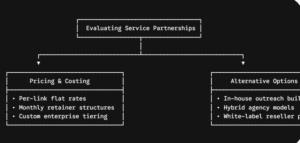
EVALUATING SERVICE PARTNERSHIPS: FRAMEWORK BREAKDOWN
When scaling organic link building campaigns, businesses must carefully evaluate potential agency partners based on their pricing models and structural alternatives. Choosing the right service framework ensures transparent costs, operational flexibility, and a clean backlink profile aligned with long-term search engine goals.
1. Pricing & Costing Models
Selecting the right pricing framework depends on your budget predictability, link volume requirements, and business growth speed.
Per-Link Flat Rates:
Pay a fixed cost for each published, verified backlink based on specific domain metrics (such as Organic Traffic, Domain Authority, or Domain Rating).
Best For: Small-to-medium businesses or agencies looking for predictable costs without recurring long-term commitments.
Monthly Retainer Structures:
A recurring monthly investment where the service provider delivers a set package of links, content creation, and ongoing prospecting every month.
Best For: Growing brands that need consistent link velocity and continuous authority building to compete in high-difficulty niches.
Custom Enterprise Tiering:
Tailored, high-volume campaign structures designed for large corporations, SaaS platforms, or e-commerce stores with complex SEO needs.
Best For: Enterprises requiring strict custom quality filters, specialized niche outreach, dedicated account managers, and custom reporting.
2. Alternative Options & Operating Models
If standard link-building packages do not fit your business structure, several alternative operational models offer varying levels of control and scalability.
In-House Outreach Builds:
Hiring, training, and managing an internal team of outreach specialists, content writers, and prospectors.
Pros: Complete control over email messaging, brand representation, and publisher selection.
Cons: High fixed operational overheads, recruitment delays, and time-consuming manual prospecting.
Hybrid Agency Models:
A collaborative approach where your in-house marketing team handles strategy, topic selection, and high-level pitching, while an external partner manages heavy manual tasks like publisher vetting and content distribution.
Pros: Combines in-house strategy with external execution speed and existing publisher networks.
White-Label Reseller Plans:
Specialized link-building delivery designed for SEO agencies, digital marketing firms, and consultants who resell link-building services to their end clients.
Pros: Unbranded, client-ready campaign reports, bulk pricing discounts, and immediate access to pre-vetted publisher networks without building internal fulfillment teams.
Analyzing campaign Costing models helps forecast return on investment based on domain authority, traffic thresholds, and niche competitiveness. If your current provider fails to meet quality standards, exploring alternative Options ensures your link profile remains clean and resilient against algorithm updates.
Securing high-quality placements ultimately builds true Authority, sending positive signals to search engines that improve domain trust and organic rankings over time.
4. Vertical-Specific Outreach Strategies
Tailoring your approach to specific industries improves placement success and audience relevance:
-
Technology & Software: Navigating the Tech sector requires pitching deep product integrations, software reviews, and technical tutorials to specialized editors.
-
E-Commerce & Retail: Executing campaigns for Retail brands centers on buyer guides, product roundups, and lifestyle publisher placements that drive direct referral sales.
-
Geographic Target Markets: Building Local search signals involves connecting with regional news outlets, local business blogs, and community sponsorships.
-
Emerging Technologies: Collaborating within Web3 networks demands specialized industry knowledge, security awareness, and active community participation.
-
B2B & Enterprise: Securing placements for Enterprise brands requires publishing original research, white papers, and thought leadership content targeting C-level decision-makers.
5. Scaling and Measuring Success
Long-term success depends on tracking performance using clear Analytics. Key performance indicators include:
-
Organic ranking movements for targeted keywords
-
Referral traffic generated from placed links
-
Velocity of indexation and page authority growth
-
Domain trust improvement across core search engines
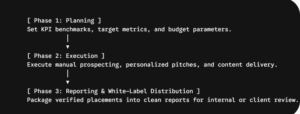
OUTREACH CAMPAIGN PHASES & TIMELINE
A systematic three-phase workflow designed to transition link building campaigns from initial strategy setup to verified, client-ready reporting.
Phase 1: Strategic Planning & Setup
Before reaching out to any publisher, a structured foundation is built to ensure every outreach effort aligns with your overarching organic search objectives.
-
Set KPI Benchmarks: Establishing clear success metrics based on baseline performance, including target organic traffic increases, domain authority goals, and desired search engine ranking movements.
-
Target Metric Definition: Defining strict quality filters for prospective host websites—such as minimum Domain Rating/Authority, real organic traffic thresholds, geographic relevance, and niche alignment.
-
Budget Parameter Allocation: Setting transparent cost-per-link budgets and timeline estimates to optimize resource allocation across content creation and outreach operations.
Phase 2: Active Campaign Execution
The core operational stage where manual prospecting, customized communication, and high-standard content creation take place.
-
Manual Prospecting & Qualification: Filtering potential publishing partners to eliminate spam networks, private blog networks (PBNs), or low-quality link farms.
-
Personalized Pitch Delivery: Reaching out directly to section editors, blog managers, and webmasters with custom topic proposals and original value offerings.
-
Editorial Content Delivery: Producing thoroughly researched, engaging articles that naturally integrate your brand mention and target landing page URLs according to publisher guidelines.
Phase 3: Reporting & White-Label Distribution
The final verification and reporting stage that ensures full transparency and long-term link performance tracking.
-
Placement Verification: Verifying live published articles to ensure proper indexation by search engine bots, correct anchor text usage, and target URL accuracy.
-
Clean Performance Packaging: Organizing all placement data, live links, site metrics, and publishing dates into structured, unbranded campaign reports.
-
Client & Internal Review: Delivering client-ready white-label reports suitable for agency reselling or executive internal presentations to demonstrate clear campaign return on investment (ROI).
When securing placements, focus on contextual link Placement within the main body of relevant articles, avoiding footers, sidebars, or author bios where link equity is diluted.
Agencies looking to expand their service catalog often partner with a specialized Reseller provider to deliver white-label outreach solutions, allowing them to offer verified link building under their own brand without expanding internal overhead.
Conclusion
Building domain authority through blogger outreach and guest posting is a continuous, strategic effort that directly affects long-term search engine performance. Success relies on maintaining high editorial standards, crafting customized value propositions for real publishers, and analyzing performance metrics consistently. Whether you execute outreach through an in-house team or collaborate with experienced partners like PB Outreach, prioritizing contextual relevance, transparent publisher relationships, and organic value will ensure your search visibility grows steadily and remains protected against algorithm updates.
Related post: Data Analytics Freelancing: The Complete Roadmap