
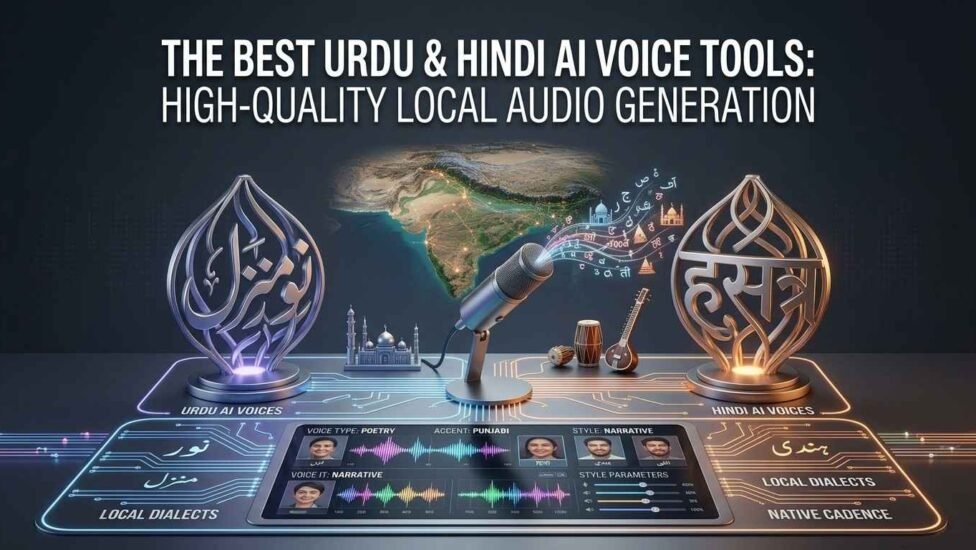
The landscape of digital content creation has undergone a massive transformation with the rise of AI voice synthesis. Just a few years ago, automated Text-to-Speech (TTS) engines producing Urdu and Hindi audio resulted in flat, monotone, and jarringly robotic sounds. These legacy engines struggled to grasp the phonetic complexity, natural pauses, and subtle emotional undertones intrinsic to South Asian languages.
Thanks to breakthroughs in deep neural networks and contextual speech algorithms, modern AI voice generators now deliver astonishingly lifelike regional speech. Today’s creators can instantly generate natural, studio-quality Urdu and Hindi voiceovers for YouTube videos, e-learning courses, commercial ads, and narrative podcasts. Below is an in-depth guide to the best AI voice generators leading the way in authentic regional speech generation.
The Evolution of South Asian AI Voice Synthesis
Languages like Urdu and Hindi possess distinct phonetic structures. Accurate pronunciation depends heavily on context, formal versus informal tone, and proper emphasis on vowels and aspirated consonants.
Modern AI voice platforms go far beyond traditional phonetic reading by offering:
-
Context-Aware Processing: Analyzing the overall sentence structure to determine whether the tone should be conversational, authoritative, or dramatic.
-
Natural Cadence and Breathing: Inserting realistic pauses at commas and sentence stops to mirror authentic human breathing.
-
Hinglish & Urdish Handling: Seamlessly blending English loanwords into Urdu or Hindi scripts without breaking the natural accent flow.
Top AI Voice Generators Supporting Native Urdu & Hindi Accents
1. ElevenLabs: Unmatched Realism and Emotional Nuance
ElevenLabs stands at the forefront of generative AI audio technology. Its multilingual neural models excel at picking up regional accents and delivering lifelike speech output in both Urdu and Hindi. The platform captures subtle vocal warmth, making it almost impossible to distinguish the AI output from a professional human voice actor.
-
Key Strengths: High emotional range, fine-tuned voice cloning capabilities, and ultra-low latency generation.
-
Best For: Audiobooks, cinematic storytelling, YouTube voiceovers, and character dubbing.
-
Explore Tool: Try the official ElevenLabs Text to Speech Landing Page to test realistic South Asian voice models directly.
2. Murf.ai: Studio-Grade Precision for Commercial Projects
Murf.ai provides a comprehensive cloud-based voice studio designed for professionals, corporate teams, and educators. It offers an extensive library of realistic voices, including specialized South Asian accents and native regional tones. Users can fine-tune pitch, emphasis, and speed on a word-by-word basis.
-
Key Strengths: Precise timeline alignment, pitch customization, and background music integration.
-
Best For: Corporate training modules, presentation voiceovers, and commercial video ads.
-
Explore Tool: Visit the Murf AI Speech Generation Landing Page to customize regional accents and adjust audio pitch settings.
3. Specialized Regional TTS Tools
Beyond global giants, specialized platforms focusing on South Asian phonetics have gained significant traction. These engines are optimized to parse complex Nastaliq (Urdu) and Devanagari (Hindi) scripts directly without losing character fidelity, making them exceptionally reliable for local media outlets.
-
Key Strengths: Direct native script rendering and optimized regional accent libraries.
-
Best For: Automated news broadcasts, regional podcasts, and interactive IVR phone menus.
Key Features to Evaluate Before Choosing an AI Voice Tool
Selecting the right AI voice generator depends on your specific workflow. Consider these four critical features:
-
Native Script Parsing: Ensure the tool can accurately render Urdu (Nastaliq/Arabic script) or Hindi (Devanagari) text without pronunciation glitches.
-
Custom Emotion and Speed Controls: Look for platforms that allow you to inject sadness, excitement, or formality, as well as adjust playback speed.
-
Voice Cloning Options: If you want to create a digital twin of your own voice in Urdu or Hindi, verify that the tool supports high-fidelity instant voice cloning.
-
Commercial Licensing & Audio Formats: Check that the platform grants full commercial rights and allows uncompressed WAV or high-quality MP3 exports.
Practical Tips to Eliminate Robotic Tones in Urdu & Hindi Audio
Even the most advanced AI engine benefits from proper script preparation. Follow these practical techniques to achieve flawless, human-sounding results:
-
Punctuate Thoughtfully: Use commas, em-dashes, and periods strategically. Pauses in South Asian storytelling dictate the mood and clarity of the message.
-
Experiment with Roman Transliteration: For casual, modern content (like tech reviews or vlogs), typing scripts in Roman Urdu or Hinglish often yields a more conversational cadence.
-
Fine-Tune Speed Settings: Set playback speeds slightly lower (e.g., 0.9x to 0.95x) when delivering dense narrative or educational content to ensure every syllable remains crystal clear.
Conclusion
AI voice synthesis has leveled the playing field for South Asian content creators, eliminating the need for expensive recording studios, high-end microphones, and complex audio engineering setups. Advanced platforms like ElevenLabs and Murf.ai make it easier than ever to produce natural, highly engaging Urdu and Hindi audio at scale. By pairing the right AI platform with well-structured scripts and careful punctuation, you can deliver professional-grade regional voiceovers for any digital project.
Related post: The Ultimate No-Watermark Guide: Clear Any Video Background Free with AI