
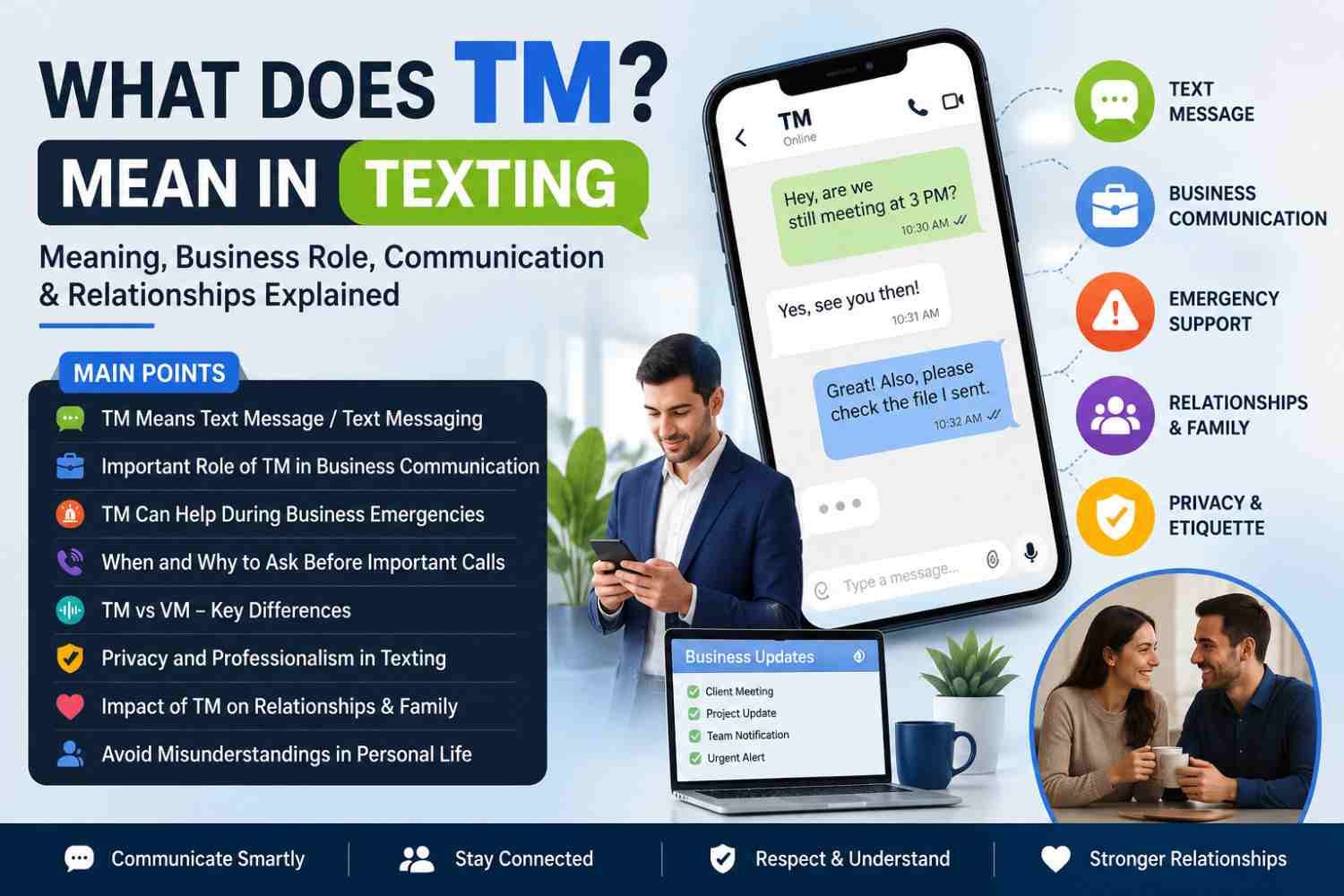
Text messaging, commonly called TM, has become one of the easiest ways to communicate in everyday life, work, and business. People use text messages to share quick information, confirm plans, discuss work, contact customers, and stay connected with family and friends. However, texting is not always the best choice for every situation. An important business decision, an emergency, or a sensitive personal conversation may require a phone call or face-to-face discussion instead.
The way we use TM also depends on the time, place, relationship, and importance of the message. A short text can save time, but relying on messages too much may sometimes create confusion or reduce real-life interaction. This guide explains what TM means, how it can be useful in business emergencies, when you should text before calling, how TM differs from VM, whether texting from a private place is appropriate, and how excessive texting can influence relationships.
What Does TM Mean in Texting?
In everyday communication, TM can mean Text Message or Text Messaging, depending on how it is used in a sentence. A text message is a written communication sent through a mobile phone or messaging service. Unlike a traditional phone call, it allows the receiver to read the information whenever they are available.
TM is useful for short and straightforward communication. For example, someone may send a message to confirm a meeting time, ask for an update, share an address, or remind another person about an appointment. Businesses also use text messaging to communicate with employees, customers, suppliers, and clients.
One major advantage of TM is convenience. You do not necessarily have to interrupt someone with a phone call. The recipient can respond when they have time. Texts also provide a written record, which can be useful when remembering dates, instructions, or other details.
However, texting has limitations. Written messages do not include voice tone or facial expressions, so a simple sentence can sometimes sound rude or confusing. For serious discussions, a call or face-to-face conversation may be more appropriate.
What Is the Role of TM in Business?
TM can play an important role in modern business communication because it provides a quick way to exchange information. Companies may use text messages for appointment reminders, customer updates, internal communication, delivery notifications, meeting confirmations, and urgent announcements.
For employees, TM can make routine communication faster. Instead of arranging a meeting for a simple question, a manager may send a short message and receive an answer quickly. Customers may also appreciate text notifications because they can read them without staying on a phone call.
Another useful feature is speed. When information needs to reach several people quickly, text messaging can be more practical than waiting for everyone to check email. For example, a business can notify employees about a schedule change or an unexpected office closure.
Nevertheless, businesses should establish reasonable communication rules. Employees should know when texting is appropriate and when a phone call, email, meeting, or official communication channel is required. Sensitive information should also be handled carefully.
TM is therefore best viewed as one communication tool rather than a replacement for every other method. When used appropriately, it can improve responsiveness while keeping everyday business communication simple.
Can TM Help During a Business Emergency?
Yes, TM can be useful during a business emergency, particularly when information needs to be delivered quickly. A short message can alert employees about an unexpected situation, such as an office closure, schedule change, technical problem, safety concern, or urgent operational update.
One benefit of texting during an emergency is that the sender does not need to wait for a person to answer a phone call. The message can be delivered and read when the recipient checks their phone. A written message can also clearly communicate essential details such as a location, meeting point, changed schedule, or immediate instruction.
However, TM should not automatically be the only communication method during a serious emergency. If immediate confirmation is necessary, a phone call may be more suitable. In situations involving safety, security, or critical operations, organizations should follow their established emergency procedures.
A good emergency text should be short and specific. It should explain what happened, what action is required, and whether the recipient needs to respond. Avoid unnecessary information that could make the main instruction difficult to notice.
The key point is that TM can support emergency communication, but its suitability depends on the seriousness and urgency of the situation. For critical matters, combining texting with another appropriate communication method may provide better reliability.
Should You Ask TM Before Making an Important Business Call?
There is no universal rule that you must send a text before every important business call. The better approach depends on the relationship, urgency, and communication habits of the person you are contacting.
For a routine or non-urgent business matter, sending a short message first can be courteous. You might ask whether the person is available for a call or briefly explain the reason for contacting them. This gives the other person an opportunity to prepare or suggest a more convenient time.
For urgent matters, however, waiting for a text response may not be practical. If the issue requires immediate attention, calling directly may be more appropriate. In professional situations, the importance of the matter should determine the communication method rather than following a rigid texting rule.
A preliminary message can also be useful when you know the person has a busy schedule. Instead of unexpectedly interrupting a meeting or another commitment, you can request a suitable time.
The main goal is respectful communication. Think about whether the call is urgent, whether the recipient normally prefers calls or messages, and whether the information can wait. Using good judgment is more valuable than automatically texting before every call.
What Is the Difference Between TM and VM?
TM and VM are different forms of communication. TM generally refers to a text message or text messaging, while VM commonly means voicemail or voice message, depending on the platform and context.
A TM communicates through written words. It is useful when you need to provide information that someone can read later, such as a time, address, reminder, short instruction, or confirmation. The recipient can review the message again without listening to a recording.
A VM communicates through recorded audio. It can be useful when explaining something would take longer in writing or when the sender wants to communicate using their voice. Voice messages can sometimes convey emotion and tone more naturally than text.
The choice between the two depends on the situation. A simple appointment confirmation may be easier through TM, while a detailed explanation may be more convenient as a VM or phone conversation.
Neither option is automatically better. Text is generally convenient for information that should be quickly scanned or saved, while voice communication may be more effective when tone, explanation, or personal expression matters.
Understanding this difference helps people select the communication format that best matches the purpose of their message.
Can You TM From a Private Place Like a Washroom?
Technically, you can send a text message from almost anywhere if you have your phone and a connection. However, the more important question is whether that location is appropriate for the particular communication.
For casual personal messages, the location may not matter much. Business communication is different. If you are handling confidential information, participating in professional work, or discussing a sensitive issue, privacy and professionalism should be considered.
A washroom is generally not an appropriate place for a business meeting, phone conversation, or important professional discussion. Sending a very short text may be unavoidable, but you should avoid conducting lengthy work conversations from a location where privacy, hygiene, or professionalism could become concerns.
Another issue is concentration. Important messages deserve attention, especially if they contain instructions, customer information, financial details, or sensitive business matters. A quiet and appropriate location reduces the possibility of mistakes.
The same principle applies to other private or distracting environments. The question is not simply whether you can send a TM there, but whether doing so is suitable for the content and purpose of the communication.
For ordinary messages, location may be insignificant. For professional or confidential matters, choosing an appropriate environment is the better practice.
Should You Discuss Important Matters With Your Wife Through TM or Face-to-Face?
For important matters between spouses, face-to-face communication is usually preferable, especially when the subject involves emotions, major decisions, disagreements, or something that requires a detailed conversation.
Texting can be useful for sharing a quick thought, arranging a time to talk, or communicating when you are temporarily apart. However, written messages do not provide the same emotional information as a direct conversation. Tone can easily be misunderstood, and a short message may appear colder or harsher than the sender intended.
Face-to-face communication allows both people to respond immediately and notice facial expressions, body language, and changes in tone. It can make it easier to clarify misunderstandings before they become bigger problems.
That does not mean every personal matter requires an in-person conversation. If the topic is simple or one person needs time to think before responding, texting may be appropriate. The important thing is to recognize when a subject has become too serious for a series of messages.
For sensitive relationship matters, choosing a calm private setting and talking directly can encourage better understanding. TM can support the conversation, but it does not always need to replace it.
Can TM Affect Our Relationships With Family and Friends?
Yes, the way people use TM can influence their relationships with family and friends. Text messaging makes it easier to stay connected, especially when people live far away or have busy schedules. A quick message can show someone that you are thinking about them even when you cannot meet in person.
The problem can arise when texting becomes the primary form of social interaction. If people constantly communicate through short messages but rarely spend meaningful time together, relationships may gradually become less personal.
Another issue is misunderstanding. Text does not always communicate humor, emotion, or intention clearly. A message that seems normal to the sender may be interpreted differently by the receiver.
Notifications can also interrupt conversations. If someone repeatedly checks their phone while sitting with family or friends, the people around them may feel ignored.
Healthy communication is usually about balance. TM can maintain connections, coordinate plans, and share everyday moments, while calls and face-to-face meetings can provide deeper interaction.
Using technology does not automatically damage relationships. The impact depends on how it is used. When texting supports real relationships rather than completely replacing personal interaction, it can be a valuable communication tool.
Can TM Create Misunderstandings Between Couples?
Yes, TM can sometimes create misunderstandings between couples because written communication removes many signals that people normally use during a conversation. When speaking face-to-face, you can hear someone’s tone and see their expression. A text message provides only the words.
For example, a short response such as “okay” may be completely neutral to one person but may appear angry or dismissive to another. Emojis can sometimes provide additional context, but they cannot always eliminate confusion.
Timing can also influence interpretation. If someone normally replies immediately but suddenly takes several hours, their partner may wonder whether something is wrong even when there is an innocent explanation.
Arguments can become worse when both people continue sending messages instead of discussing the issue directly. Each new message can introduce another misunderstanding.
For this reason, couples may benefit from moving an emotionally sensitive discussion from TM to a call or face-to-face conversation. A message can be used to say that a conversation is needed, rather than trying to resolve every issue through text.
The healthiest approach is not to avoid TM completely but to understand its limitations. Simple communication works well through text, while emotional or complicated matters often deserve a more direct conversation.
Frequently Asked Questions About TM
What Does TM Mean in Texting?
TM usually means Text Message or Text Messaging. It refers to written communication sent through a mobile phone or messaging service. People use TM for quick updates, reminders, meeting confirmations, addresses, and everyday communication.
Is TM Useful for Business Communication?
Yes, TM can be useful for business communication because it allows companies and employees to exchange information quickly. Businesses can use it for appointment reminders, customer updates, meeting confirmations, delivery notifications, and urgent announcements.
Is TM Good for Business Emergencies?
TM can help during a business emergency when important information needs to reach people quickly. A short message can communicate an office closure, schedule change, technical issue, safety concern, or urgent instruction. For critical situations, however, a phone call or established emergency procedure may also be necessary.
What Is the Difference Between TM and VM?
TM is generally a text message, while VM commonly means voicemail or voice message. TM uses written words and is convenient for information that needs to be read or saved. VM uses recorded audio and can be better when tone, emotion, or a longer explanation is important.
Can Too Much TM Affect Personal Relationships?
Yes, excessive texting can sometimes affect personal relationships if it replaces meaningful face-to-face interaction. Written messages can also cause misunderstandings because they do not show facial expressions or tone. Using TM as a way to stay connected while maintaining real conversations can create a healthier balance.