
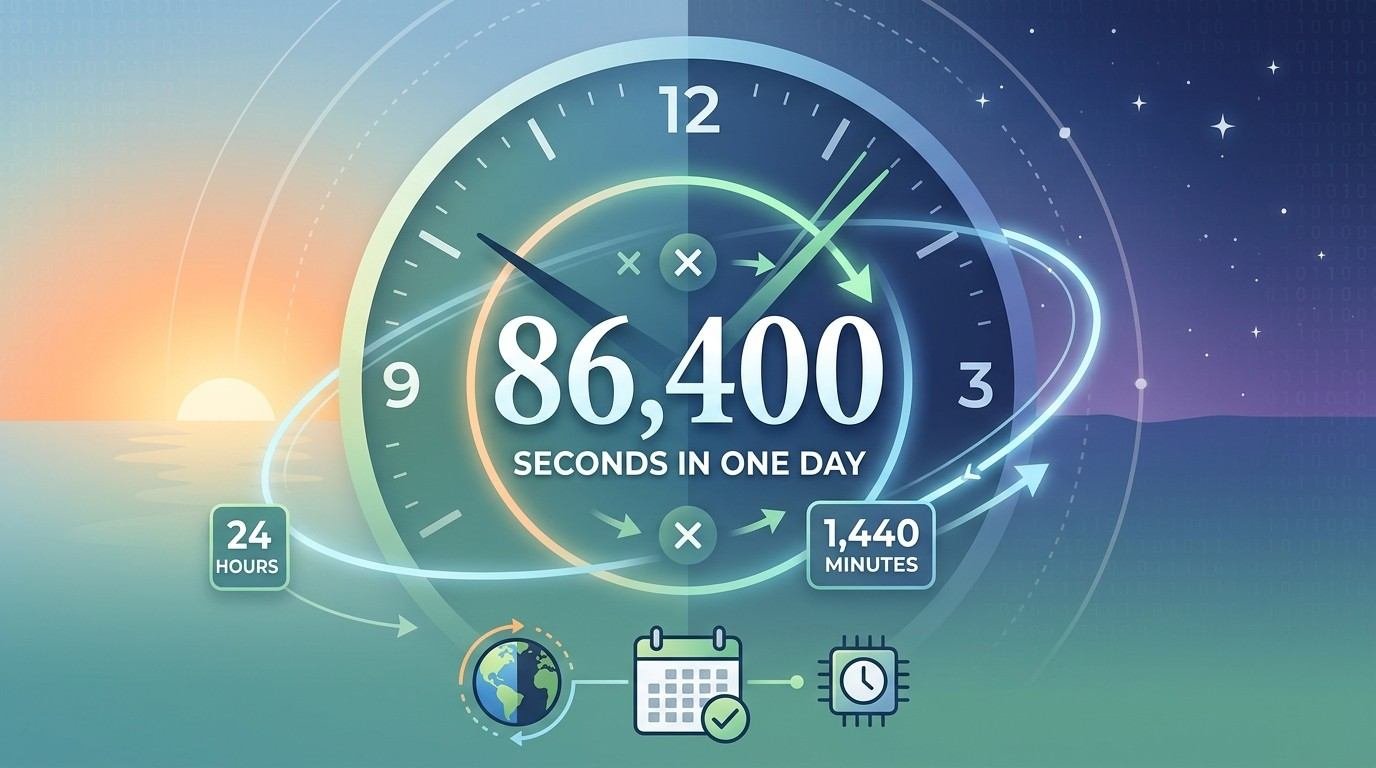
Time is one of the few universal constants that governs human life. From setting morning alarms to launching satellites into space, our daily routines depend entirely on a shared system of measurement. While we naturally organize our schedules around hours and minutes, measuring time down to its smallest standard unit—the second—reveals how remarkably engineered our calendar really is.
Understanding the exact breakdown of time provides a clearer perspective on how every single moment adds up across days, months, and years.
Breaking Down the Standard 24-Hour Cycle
To determine how many seconds are in a 24-hour period, you do not need complex tools. The math relies on basic time conversions that build upon each other step by step.
From Hours to Minutes to Seconds: Simple Step-by-Step Math
The system we use today is based on sexagesimal (base-60) arithmetic, an ancient framework inherited from early civilizations:
Start with the primary unit: There are 24 hours in 1 day.
Convert hours to minutes: Each hour contains 60 minutes. Multiplying $24 \times 60$ gives 1,440 minutes in a full cycle.
Convert minutes to seconds: Each minute consists of 60 seconds. Multiplying $1,440 \times 60$ yields the final result.
The basic mathematical formula to calculate this unit total is straightforward:
$$\text{Total Seconds} = 24 \times 60 \times 60$$
Using this simple daily converter logic, you find that 1 full standard solar day equals exactly 86400 seconds.
Why 86,400 is the Universal Daily Time Benchmark
The number 86400 serves as the global baseline for international timekeeping, financial transactions, global positioning systems (GPS), and digital server timestamps. Whether a computer program runs a daily backup or an airline manages international flight schedules, this uniform unit count ensures that software systems around the world remain synchronized.
Scientific & Astronomical Nuances
While 86400 is the standard mathematical figure, nature is slightly more complex. Earth does not rotate in a perfectly rigid, unchanging manner, which creates small variations between civil time and astronomical realities. To maintain global precision across scientific research and navigation, institutions like the National Institute of Standards and Technology (NIST) continuously monitor and broadcast official time standards.
Solar Days vs. Sidereal Time
When we measure time based on the sun’s position in the sky, we are referring to a solar day. This is the time it takes for the sun to return to the exact same meridian, averaging right at 24 hours.
However, astronomers also measure Earth’s rotation relative to distant background stars. This is known as a sidereal day:
Solar Day: Approximately 24 hours (86,400 seconds).
-
Sidereal Day: Approximately 23 hours, 56 minutes, and 4.09 seconds (about 86,164 seconds).
Because Earth is orbiting the sun while simultaneously spinning on its axis, it has to rotate slightly more than $360^\circ$ to bring the sun back to the same spot in the sky. This creates a difference of roughly four minutes every single day between astronomical observation and civil clock time.
How Leap Seconds Adjust the Earth’s Rotation Realities
Earth’s rotation is gradually slowing down over long periods due to tidal friction caused by the moon’s gravitational pull. Because of this, the exact length of a real solar day fluctuates by tiny fractions of a second.
To keep atomic clocks aligned with Earth’s actual spin, scientists periodically insert a “leap second.” Official announcements and adjustments regarding international time scales are coordinated globally by the International Earth Rotation and Reference Systems Service (IERS) . While these adjustments are rare, they highlight that Earth’s natural rhythm requires occasional fine-tuning to keep international time standards precise.
Scaling Time: From Seconds to Years
Once you master the daily baseline calculation, it becomes easy to scale time up to larger calendar units.
| Time Unit | Calculation Formula | Total Seconds (Approx.) |
|---|---|---|
| 1 Hour | 60 × 60 sec | 3,600 |
| 1 Day | 24 × 3,600 | 86,400 |
| 1 Week | 7 × 86,400 | 604,800 |
| 1 Month (30 Days) | 30 × 86,400 | 2,592,000 |
| 1 Year (365 Days) | 365 × 86,400 | 31,536,000 |
During a leap year, an extra day is added to February, bringing the annual total to 366 days, or 31,622,400 seconds.
Real-World Applications in Computing and Physics
Precision time tracking is crucial in modern technology:
-
Unix Epoch Timestamps: Computer operating systems keep track of time by counting the total number of seconds elapsed since January 1, 1970. Every day that passes increments this counter by 86,400.
-
Satellite Navigation: GPS networks transmit signals timed to nanosecond precision. A discrepancy of even a fraction of a second would cause navigation positioning errors of several miles.
-
High-Frequency Trading: Financial markets execute thousands of trades per second. Accurate synchronization ensures transactions are logged in the precise order they occur.
Understanding how moments build into hours—and how those hours form a complete day—reminds us of the structured precision behind every tick of the clock.