

Search engine optimization has transformed from a niche technical task into a fundamental business requirement. Whether managing digital campaigns for global corporate brands or helping small regional businesses grow online, today’s digital landscape requires clear execution, structured career progression, and data-driven strategy.
Section 1: Decoding the SEO Hierarchy & Job Matrix
The career path in search optimization spans multiple distinct stages. Beginners usually enter the industry as a junior Executive or specialized Analyst, focusing on daily task execution such as data collecting and basic tracking. As skills sharpen, professionals move into a dedicated Specialist role, taking end-to-end ownership over campaign strategy, keyword planning, and implementation.

Stage 1: Junior Executive / Analyst (Entry Level: 0–2 Years)
This is the starting point of an SEO career, where the primary focus is on execution, daily operations, and data collection. Instead of creating strategies, an entry-level professional executes the directions provided by seniors.
Core Responsibilities:
-
Data Gathering & Tracking: Recording daily/weekly keyword rankings, organic traffic trends, and site health metrics.
-
Basic On-Page Execution: Updating title tags, meta descriptions, alt text, and heading tags (H1–H6).
-
Basic Technical Checks: Pinpointing broken links (404 errors), redirect chains, and crawl errors.
-
Off-Page Support: Preparing link prospecting lists and drafting outreach emails for link-building campaigns.
Tools Used Daily:
-
Google Search Console, Google Analytics 4 (GA4), Screaming Frog (Basic Crawls), Google Sheets / Excel.
Key Performance Indicators (KPIs):
-
Task completion accuracy, data precision, and maintaining daily operational checklists.
Stage 2: Specialist (Mid-Level: 2–5 Years)
At this stage, the professional becomes independent. Rather than just following tasks, they now build campaign strategies, resolve complex technical issues, and drive ranking growth.
Core Responsibilities:
-
Advanced Keyword Strategy: Discovering high-intent commercial keywords and mapping topic clusters/content hubs.
-
Technical SEO Audits: Handling Core Web Vitals, schema markup (structured data), XML sitemaps, robots.txt, and crawl budget optimization.
-
Content & On-Page Leadership: Creating SEO briefs for writers, identifying thin/duplicate content, and directing conversion-focused copywriting.
-
Digital PR & Link Acquisition: Securing contextual guest posts, brand mentions, and niche edits from high-authority websites.
Tools Used Daily:
-
Ahrefs, Semrush, Google Tag Manager, Screaming Frog (Advanced Regex/Custom Extraction), PageSpeed Insights.
Key Performance Indicators (KPIs):
-
Organic traffic growth, target keyword ranking improvements, and maximizing qualified organic leads/conversions.
Stage 3: Senior Strategist / Manager (Senior Level: 5+ Years)
This represents the leadership and executive level. Focus shifts from hands-on execution toward business growth, team management, cross-department alignment, and delivering measurable ROI.
Core Responsibilities:
-
High-Level Strategy & Vision: Preparing long-term organic roadmaps aligned with overall business revenue goals.
-
Team & Resource Management: Training junior executives and specialists, assigning task workflows, and delegating responsibilities across content and development teams.
-
Client & Stakeholder Communication: Presenting executive reports and demonstrating the ROI of organic performance to clients and C-level executives.
-
Algorithm Adaptation & Risk Mitigation: Analyzing search engine algorithm updates to protect the overall site portfolio from penalties or traffic drops.
Tools Used Daily:
-
Looker Studio (Data Visualization), Enterprise Analytics, Project Management Tools (Asana, Jira, Trello), Competitor Benchmarking Platforms.
Key Performance Indicators (KPIs):
-
Total Organic Revenue / Pipeline, ROI on SEO Budget, Team Efficiency, and Customer Acquisition Cost (CAC) Reduction.
| Metric / Dimension | Stage 1: Executive / Analyst | Stage 2: Specialist | Stage 3: Senior Strategist / Manager |
|---|---|---|---|
| Primary Mindset | Doer & Data Collector | Problem Solver & Optimizer | Business Growth Leader & Architect |
| Work Independence | Requires supervision | Works independently | Leads teams & dictates strategy |
| Focus Area | Single task execution | Full SEO campaign performance | Business ROI, revenue & retention |
| Primary Skill | Basic SEO tools & Excel | Deep technical & tactical SEO | Leadership, analytics & revenue strategy |
Evolution of Search Roles: Navigating the Spectrum from Junior SEO Executive to Team Lead
Advancing through the ranks requires expanding both technical knowledge and decision-making capabilities. A novice focuses primarily on operational tasks like gathering rank updates or organizing link prospects. Beyond entry-level execution, a mid-level professional becomes an effective Optimizer, actively refining web pages and adjusting strategies based on algorithmic changes.
Moving into senior positions—such as a project Manager or team lead—demands a broader operational mindset. Senior leaders guide team workflows, assign campaign priorities, manage client communication, and align search performance directly with overarching business goals.
Specialized Career Tracks: On-Page, Off-Page, Technical & Analytical SEO Profiles
Modern digital strategy demands specialized expertise rather than broad, surface-level knowledge. Professionals often branch out into specific operational tracks:
-
Technical Expertise: A dedicated digital Technician focuses on technical health, crawling efficiency, server log analysis, site speed, and indexation stability.
-
Content & Structure: A site Architect shapes information architecture, designs scalable URL structures, and guides canonical setup.
-
Authority Building: An active campaign Promoter leads off-site digital PR, managing high-authority brand mention strategies and strategic partnership outreach.
Job Title Breakdown: Choosing the Right Designation for Your Resume & Career Growth
Different job titles reflect distinct day-to-day responsibilities within an organization:
| Role Title | Core Operational Focus |
|---|---|
| Marketer | Manages broad promotional alignment, user acquisition, and multi-channel campaign integration. |
| Architect | Focuses on web structure, crawl paths, and structural content taxonomy. |
| Technician | Handles speed optimization, core web vitals, and technical site health. |
| Outreach | Coordinates digital PR, publisher relationships, and contextual link acquisition. |
Selecting the right designation on a resume ensures recruiters instantly recognize your primary strengths, whether you are positioning yourself as a broad digital lead or a deep technical subject expert.
Section 2: High-Impact Core Competencies Every Modern SEO Needs
To deliver consistent traffic growth, digital search professionals rely on a proven set of technical and strategic skills.
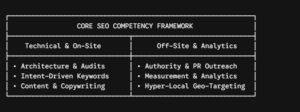
Pillar 1: Technical & On-Site SEO
This pillar focuses on optimizing everything directly on the website to ensure search engine crawlers can efficiently index the site and users find high-value, relevant content.
1. Architecture & Audits
-
Crawlability & Indexability: Ensuring search engines can easily discover, crawl, and index pages using proper
robots.txtrules and XML sitemaps. -
Site Structure & Internal Linking: Designing a logical, shallow site hierarchy (e.g., Silo Architecture / Topic Clusters) so link equity flows efficiently to critical pages.
-
Technical Health Audits: Performing routine checks to fix broken links (404 errors), unwanted 301 redirect chains, duplicate content issues, and canonical tag misconfigurations.
-
Core Web Vitals & Performance: Optimizing page load speeds, server response times (TTFB), Largest Contentful Paint (LCP), and Cumulative Layout Shift (CLS) for seamless mobile and desktop user experiences.
2. Intent-Driven Keywords
-
Search Intent Mapping: Classifying queries by user intent—Informational, Navigational, Commercial, or Transactional—to align content with user expectations.
-
Keyword Research & Gap Analysis: Identifying high-value primary and secondary keywords, as well as finding keyword gaps where competitors are outranking the site.
-
Cannibalization Prevention: Ensuring unique primary keywords are assigned to individual pages so multiple pages from the same site do not compete against each other in Search Engine Results Pages (SERPs).
3. Content & Copywriting
-
On-Page Optimization: Structuring metadata (title tags, meta descriptions), heading tags (
H1–H6), URL slugs, and image alt text for maximum contextual relevance. -
E-E-A-T & Quality: Crafting original, comprehensive content that demonstrates Experience, Expertise, Authoritativeness, and Trustworthiness.
-
Semantic Search & Entities: Incorporating natural language processing (NLP) terms, LSI keywords, and Schema Markup (Structured Data) to help search engines understand page context beyond basic keyword matching.
Pillar 2: Off-Site & Analytics
This pillar focuses on building external site authority, establishing brand trust across the web, and measuring performance using data-driven tools.
1. Authority & PR Outreach
-
Digital PR & Brand Mentions: Securing mentions and coverage on authoritative news sites, industry blogs, and trade publications.
-
Contextual Backlink Acquisition: Building high-quality, relevant external links through guest publishing, resource page inclusions, broken link building, and unlinked brand mention reclamation.
-
Toxic Link & Profile Management: Monitoring link profiles to identify spammy link farm networks and submitting disavow files when necessary to prevent algorithmic penalties.
2. Measurement & Analytics
-
Performance Tracking (Google Search Console): Monitoring search impressions, clicks, click-through rates (CTR), average position, and indexing errors.
-
Behavioral & Conversion Analytics (GA4): Tracking user event paths, engagement rates, session duration, landing page conversion rates, and funnel drop-offs.
-
Data Visualization & Reporting: Building executive dashboards in tools like Looker Studio to communicate search channel ROI directly to stakeholders and clients.
3. Hyper-Local Geo-Targeting
-
Google Business Profile (GBP) Optimization: Setting up, verifying, and continuously optimizing GBP listings with updated categories, business hours, geotagged photos, and regular posts.
-
NAP Consistency & Local Citations: Standardizing Name, Address, and Phone number details across top online directories (e.g., Yelp, YellowPages, local chambers of commerce).
-
Localized Content & Review Strategy: Generating location-specific landing pages, earning genuine positive customer reviews, and optimizing for “near me” local map pack queries.
| Metric / Dimension | Technical & On-Site | Off-Site & Analytics |
|---|---|---|
| Primary Objective | Optimize site health, structure, and content relevancy | Build domain authority, measure traffic, and capture local demand |
| Key Deliverables | Technical audits, keyword maps, optimized copy, schema markup | Digital PR campaigns, backlink profiles, GA4 reports, GBP setups |
| Primary Tools | Screaming Frog, PageSpeed Insights, Yoast/RankMath, SurferSEO | Ahrefs, Semrush, Google Search Console, GA4, Looker Studio |
| Impact on Ranking | Forms the essential foundation required for indexing and ranking | Drives competitive page-one push and establishes market authority |
Technical Mastery: Auditing Architecture, Core Web Vitals, and Crawl Budget Efficiency
A strong technical base is essential for organic search success. Before attempting off-site promotion, a complete site Audit must evaluate indexation status, render delays, mobile usability, and broken internal redirects. Resolving crawling barriers ensures search engines accurately interpret page content without wasting crawl budget. For official guidance on maintaining healthy crawling and indexing health, consult the Google Search Essentials.
Strategic Keyword & Content Frameworks: Finding and Ranking High-Value Intent Keywords
Targeting search traffic effectively begins with deep research into user search intent. Mapping high-intent Keywords across landing pages, blog content, and product pages prevents content cannibalization. Optimization goes beyond matching exact terms—it requires satisfying the specific information or purchasing need behind every query.
Authority Building & Off-Page Tactics: Link Acquisition and Strategic Outreach Protocols
Search engines weigh off-site signals heavily when ranking competitive queries. Establishing domain authority demands a proactive Outreach campaign that connects with relevant industry blogs, news sites, and niche publishers. Securing earned placements and qualitative backlinks builds natural domain trustworthiness over time.
Data-Driven Performance Analytics: Mastering Google Analytics 4 (GA4) & Search Console Insights
Refining campaigns requires continuous measurement and behavioral insight:
-
On-Page Optimization: Refining metadata, heading structures, and semantic keywords directly on the target URL.
-
Off-Page Strategy: Building brand citations, social signals, and authoritative external links.
-
Analytics Integration: Monitoring visitor drop-offs, user conversion paths, and organic landing page activity via Google Analytics 4. To learn more about tracking user engagement and setting up custom reports, refer to the Google Analytics Help Center.
-
Performance Tracking: Measuring search impressions, click-through rates (CTR), and page rankings using Google Search Console.
Regular data review prevents reactive decision-making and keeps campaign iterations tied directly to verifiable user behavior.
Hyper-Local Optimization: Dominating Google Business Profile & Local Search Map Packs
For regional companies and storefront businesses, Local visibility drives foot traffic and phone leads. Maintaining an accurate Google Business Profile, accumulating verified reviews, and standardizing Name, Address, and Phone (NAP) details ensure strong local map pack presence.
Section 3: Productizing Your SEO Knowledge for Freelancing & Client Acquisition
Transitioning from an internal corporate role into independent service delivery requires packaging technical expertise into clear, client-ready offerings.

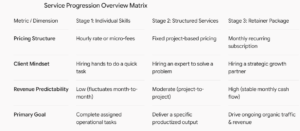
Stage 1: Individual Skills (Execution Level)
At this initial stage, the professional possesses discrete technical abilities but sells them as fragmented, a-la-carte tasks.
Key Characteristics:
-
Pricing Model: Hourly billing or low-cost transactional pricing (e.g., $15–$30/hour).
-
Client Perception: Viewed as a task-oriented contractor or virtual assistant.
-
Workload Dynamics: High labor intensity with unpredictable income cycles.
Typical Individual Skill Offers:
-
Writing title tags and meta descriptions for 10 pages.
-
Fixing 404 broken link errors.
-
Running a basic keyword research report.
-
Setting up Google Analytics 4 (GA4) or Google Search Console (GSC).
Stage 2: Structured Services (Productized Offerings)
In this mid-tier phase, the professional packages individual skills into outcome-based, clear deliverables. Instead of selling hours, they sell a fixed-scope productized service.
Key Characteristics:
-
Pricing Model: Fixed project fee (e.g., $500–$2,500 per project).
-
Client Perception: Viewed as a specialized subject matter expert or consultant.
-
Workload Dynamics: Standardized processes (SOPs) allow faster turnaround and higher profit margins.
Typical Structured Service Offerings:
-
Technical Health Audit: A comprehensive evaluation of site speed, crawl errors, schema markup, and site architecture with an actionable roadmap.
-
E-Commerce On-Page Optimization: Complete meta, heading, and internal linking overhaul for up to 50 product collection pages.
-
Local Business Map Pack Setup: GBP listing setup, citation building, and review management system for regional storefronts.
Stage 3: Retainer Packages (Recurring High-Ticket Growth)
The final stage represents scalable agency/consultant operations. Structured services are combined with ongoing strategic management into monthly recurring contracts.
Key Characteristics:
-
Pricing Model: Monthly recurring retainer (e.g., $1,500–$5,000+/month).
-
Client Perception: Viewed as a strategic partner critical to long-term business growth.
-
Workload Dynamics: Predictable revenue, long-term client retention, and sustainable growth.
Typical Retainer Package Structure:
-
Month 1 (Setup & Foundation): In-depth technical diagnostics, competitor benchmarking, and keyword mapping.
-
Ongoing Monthly Deliverables:
-
Technical maintenance and Core Web Vitals monitoring.
-
Publication of 4–8 search-optimized blog articles or product pages.
-
Digital PR outreach and contextual authority acquisition.
-
Executive Looker Studio performance dashboard updates and monthly strategic alignment calls.
-
Niche-Specific SEO Offerings: Positioning Yourself as an E-commerce or Local Business Specialist
Generalist pitches struggle to capture high-value clients. Positioning oneself as an Ecommerce expert immediately signals a deep understanding of product schema markup, collection page pagination, facet filtering issues, and cart abandonment funnel optimization.
High-Ticket Service Suites: Packaging Technical Audits and Monthly Optimization Retainers
Clients prefer predictable, outcome-oriented offerings over hourly billing. Offering comprehensive web Diagnostics pinpoints security flaws, indexation errors, and page speed bottlenecks before building a long-term retainer. Pairing upfront technical fixing with ongoing strategic growth creates clear client value.
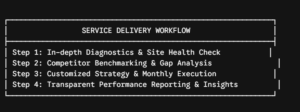
Before launching any optimization efforts, a complete technical and structural audit is performed to establish a performance baseline and resolve indexation bottlenecks.
-
Technical Crawl Analysis: Running full-site crawls using tools like Screaming Frog to identify broken links (404s), redirect loops, duplicate content, and canonicalization errors.
-
Indexing & Architecture Verification: Checking XML sitemaps,
robots.txtdirectives, and URL structures to ensure search bots can crawl and index high-priority pages efficient. -
Core Web Vitals & UX Audit: Evaluating page load speed, mobile usability, Largest Contentful Paint (LCP), and Cumulative Layout Shift (CLS) scores.
-
On-Page & Schema Review: Inspecting title tags, meta descriptions, heading structures (
H1–H6), and structured data (JSON-LD) implementation.
Analyzing the competitive landscape helps identify market opportunities, target keyword overlap, and content gaps required to outrank industry rivals.
-
Organic Keyword Gap Analysis: Comparing client domain rankings against top 3–5 market competitors to discover high-value keywords the client is missing.
-
Content Structure & Quality Evaluation: Assessing competitor content depth, search intent alignment, and topic cluster layouts.
-
Backlink Profile Benchmarking: Evaluating competitor domain authority, backlink acquisition velocity, anchor text distributions, and link sources using Ahrefs or Semrush.
-
SERP Feature Analysis: Identifying featured snippet opportunities, People Also Ask (PAA) blocks, and local map pack dominance across core target queries.
Translating audit findings into a prioritized, actionable roadmap executed across ongoing monthly deliverables.
-
Keyword Mapping & Content Briefs: Assigning primary and secondary keywords to specific landing pages and generating detailed briefs for writers.
-
On-Page & Technical Remediation: Implementing technical fixes, optimizing existing content, and improving internal linking structure.
-
Content Creation & Optimization: Publishing high-quality, intent-focused articles or landing pages designed to build topical authority.
-
Digital PR & Authority Acquisition: Conducting outreach campaigns to secure contextual backlinks, brand mentions, and high-authority publisher inclusions.
Measuring campaign performance against key business metrics and refining strategy based on real-world user data.
-
Analytics & Search Console Tracking: Monitoring traffic trends, organic click-through rates (CTR), impressions, and landing page conversions in GA4 and GSC.
-
Custom Executive Dashboards: Building real-time Looker Studio reports displaying keyword rank movements, traffic growth, and conversion funnels.
-
Monthly Strategy Calls: Reviewing completed deliverables, explaining data insights, and outlining the action items for the upcoming month.
-
Iterative Adjustments: Adapting campaign tactics to address search engine algorithm updates and shifting market trends.
| Workflow Phase | Core Deliverable | Key Tools Used | Business Impact |
|---|---|---|---|
| Step 1: Diagnostics | Technical Audit Report & Health Checklist | Screaming Frog, PageSpeed Insights, Search Console | Removes crawling barriers and stabilizes site foundation |
| Step 2: Benchmarking | Keyword & Content Gap Matrix | Ahrefs, Semrush, Google SERPs | Uncovers high-ROI content opportunities and competitive advantages |
| Step 3: Execution | On-Page Optimization & Digital PR Outreach | SurferSEO, Google Docs, Pitchbox | Drives organic keyword rankings and domain authority |
| Step 4: Reporting | Looker Studio Dashboard & Strategy Roadmap | GA4, Looker Studio, Google Search Console | Demonstrates campaign ROI and guides data-driven expansion |
Conversion-Focused Freelance Messaging: Turning SEO Expertise into Scalable Client Packages
Independent providers must communicate strategic value effectively:
-
Consulting: Guiding in-house marketing teams with high-level advice, technical blueprints, and custom search strategies.
-
Benchmarking: Comparing a business’s current organic reach directly against its top market competitors to highlight clear growth opportunities.
-
Geo-Targeting: Tailoring content and local citations to capture location-specific search queries in targeted postal codes or cities.
-
Copywriting: Producing authoritative, intent-matched content that balances reader engagement with strategic search visibility.
Conclusion
Mastering search engine optimization is an evolving journey that blends technical precision with strategic marketing vision. Whether operating as a full-time corporate team member, a dedicated digital Strategist, or an independent Freelancer, success comes down to continuous learning, data-driven adaptation, and delivering measurable organic value. By mastering core technical competencies and productizing specialized services, search professionals can build long-term career stability and consistently drive impactful growth in an ever-changing digital landscape.